
Introduction
Compliance.ai is a RegTech company that offers software solutions to assist organizations in managing regulatory compliance and risk. At its core, the compliance.ai regulatory change management platform is designed specifically for highly regulated sectors, such as banking and financial services, to help them navigate complex legal landscapes.
Background of Compliance.ai
In early 2024, the company reached a major milestone when it was acquired by Archer, a leader in enterprise risk management. This acquisition meant that the compliance.ai regulatory change management platform with its specialized system for tracking rules and regulations became an integrated part of Archer’s broader suite for managing risk and ensuring corporate compliance. Today, Compliance.ai’s system operates directly inside Archer’s infrastructure.
About and Investors
-
The Hub Strategy: Operating from San Francisco positioned the company to lead in AI and Machine Learning advancements. This proximity to Silicon Valley expertise was crucial for creating their “Expert-in-the-Loop” (EITL) framework, which combines proprietary algorithms with human supervision.
-
Funding ($13M – $17M Total Acquired): The funding history of the company indicates consistent, measured growth rather than the rapid expenditure approach seen in certain startups.
-
Series A: Directed by Cota Capital, centered on developing the fundamental AI engine.
-
Series B (2022): Obtained approximately $6 million, spearheaded by Cota Capital and JAM FINTOP.
-
Strategic Investors: JAM FINTOP’s participation was crucial, as they are supported by a vast network of local banks.
-
Founders and Leadership
The firm was established by experienced entrepreneurs with strong backgrounds in technology and security.
-
Kayvan Alikhani (Co-founder & Chief Strategy Officer): An occasional speaker on RegTech, Kayvan previously established Passlogy (identity management) and was employed at RSA, a prominent security company. He concentrated on the “interoperability” of data ensuring various compliance systems were able to communicate with one another.

-
Danielle Deibler (Co-founder): With experience in high-performance computing and gaming (previously at Adobe and IGN), she contributed the technical “engine” to the company, concentrating on how AI can handle large datasets efficiently.

-
Recent Leadership: In recent years, Asif Alam was designated as CEO to propel strategic growth, particularly in the banking and insurance industries, steering the company successfully through the Archer acquisition.

Our Portfolio Makeuser
What It Actually Does
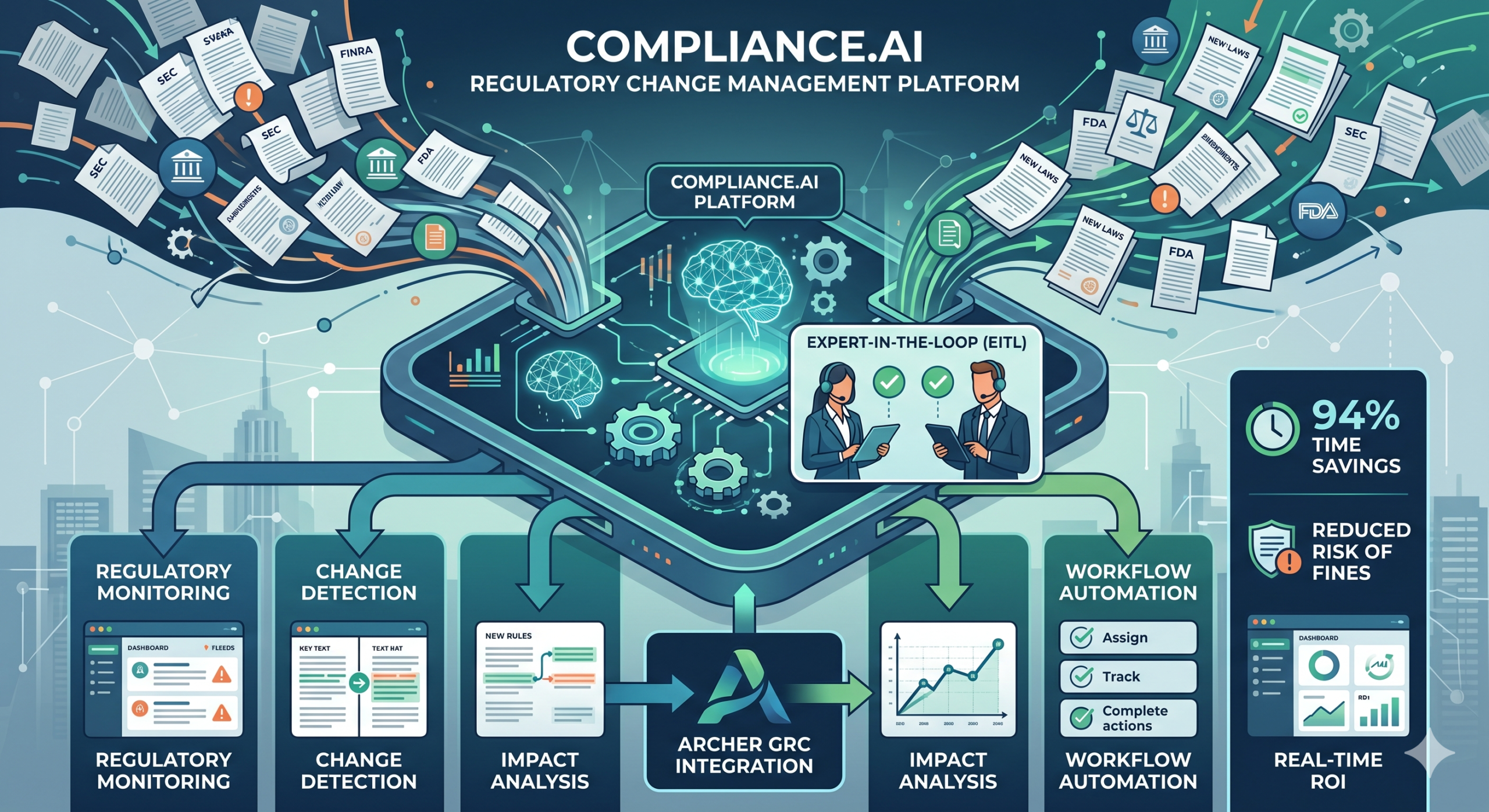
The compliance.ai regulatory change management platform is a tool that helps companies handle changes in the law in an automated way. Here is a clearer explanation of how it works:
-
Monitors Sources Using Intelligence: It uses computers to constantly check thousands of sources, like government websites and legal documents, for new information. This saves time and ensures nothing important is missed by eliminating manual checks.
-
Finds Changes That Matter: Not every law applies to every company. The platform filters out irrelevant information, highlighting only the updates that affect a specific company or industry.
-
Explains Meanings and Actions: After finding changes, it explains them in simple terms. It shows what actions the company needs to take, which departments are affected, and what steps to follow.
-
Manages Compliance Teamwork: It helps teams manage tasks by assigning responsibilities, tracking progress, and keeping records. This ensures all necessary work is done on time and provides a reliable trail for audits and inspections.
Key Features
-
Regulatory Monitoring: Keeps track of regulatory bodies and official sources to catch new updates or changes in laws automatically.
-
Change Detection: Identifies what has changed in regulations, ignores irrelevant data, and highlights vital updates so compliance teams can quickly understand developments.
-
Impact Analysis: Explains how changes affect a company’s policies and operations, making decision-making easier by outlining exactly what needs to be updated.
-
Workflow Automation: Organizes and manages compliance tasks by assigning responsibilities and tracking progress, ensuring teams work together effectively and efficiently.
-
Dashboards & Reporting: Provides visual dashboards and reports showing the organization’s compliance status, making it easier for management to identify risks, track progress, and prepare for audits.
Why Companies Use It
-
Automated Regulatory Change Management (RCM): Volume is a compliance officer’s biggest headache, with tens of thousands of pages of new rules appearing globally every year. Using the compliance.ai regulatory change management platform, companies can automatically check over 500 government sites daily. It filters the noise so a bank only sees banking laws, and a health firm only sees health regulations.
-
AI-on-AI Governance Gap: A key priority for 2026 is the EU AI Act and the NIST AI Risk Management Framework. Because AI is now a critical factor in every job, Compliance.ai watches these specific laws to ensure that a company’s working AIs comply and do not exhibit biased or illegal algorithms.
-
‘Expert in the Loop’ Accuracy: Generic AI can hallucinate or misinterpret complex legal terminology. Compliance.ai uses a mixed model where a community of experts (including compliance officers and lawyers) reviews the AI output. This adds a critical layer of security before a company changes its internal processes.
-
Operational Efficiency: Manual compliance is laborious. When auditors ask how a company responded to new privacy laws, departments can show the automated trail generated by the platform. This reduces labor costs and allows high-cost legal staff to focus on critical risk decisions.
-
Reduce Risk (‘The Miss’): The industry’s greatest fear is missing a single rule, which can cost millions in fines. The platform offers predictive intelligence, forecasting regulatory changes based on current enforcement actions (e.g., a potential clamp-down in a specific fintech sector).
Real-World ROI: By the Numbers
When organizations adopt the compliance.ai regulatory change management platform, the reduction in manual labor is staggering. In a study of 11 financial services companies transitioning to Compliance.ai, the platform demonstrated massive operational cost savings.
-
The 94% Reduction: On average, compliance teams had to sift through roughly 25,537 regulatory agency documents. Compliance.ai filtered this massive volume down to just 585 highly relevant documents.
-
Massive Time Savings: By stripping away 94% of the irrelevant noise, compliance teams saved an astonishing average of 87 days of manual work every six months.
-
Lower Operational Costs: These time savings directly translated into reducing overall compliance operational costs by over 30%, allowing highly paid legal and compliance experts to focus on strategic risk decisions instead of manual document sorting.
The Shift to “Cognitive GRC”
When Archer integrated the compliance.ai regulatory change management platform into its ecosystem in early 2024, it wasn’t just a routine tech merger—it was a leap into “Cognitive GRC” (Governance, Risk, and Compliance).
-
According to industry analysts, integrating Compliance.ai’s robust AI platform transformed Archer from a traditional risk management provider into a cognitive powerhouse.
-
Bill Diaz, CEO of Archer, noted that the integration provides clients with predictive analysis and real-time mapping of regulations directly to a company’s internal controls. This means the system doesn’t just tell you a law changed; it automatically connects that law to the specific company policy that needs to be rewritten.
What is Going on Nowadays?
In 2026, the compliance.ai regulatory change management platform has evolved into much more than a standalone tool under Archer’s guidance. It has turned into the “regulatory mind” for several of the globe’s biggest financial organizations. Today, its key function is actively assisting organizations in understanding and implementing the EU AI Act and the NIST AI Risk Management Framework, which have emerged as the primary focus for legal and compliance teams globally.