
The Ultimate Guide to Payments Compliance in 2026: Navigating PCI, AML, and Global Regulations

A comprehensive futuristic infographic titled "THE ULTIMATE GUIDE TO PAYMENTS COMPLIANCE IN 2026." A large central locked shield on a world map connects to four specialized pillars: Secure Payment Data (PCI DSS 4.0), Identity Verification (KYC & KYB), Anti-Money Laundering (AML), and Global & Regional Regulations. Each pillar details specific requirements like tokenization, facial biometrics, fraud detection dashboards, and regional laws like PSD2 and CCPA.

The global payments ecosystem is expanding at unprecedented speed. With the rise of cross-border commerce, embedded finance, and alternative payment methods (APMs), moving money has never been easier. However, this frictionless digital economy has introduced a massive counter-weight: the overwhelming complexity of payments compliance. In the past, achieving payments compliance simply meant keeping credit card … Read more
How to Build a Marketplace Database That Won’t Keep You Up at Night

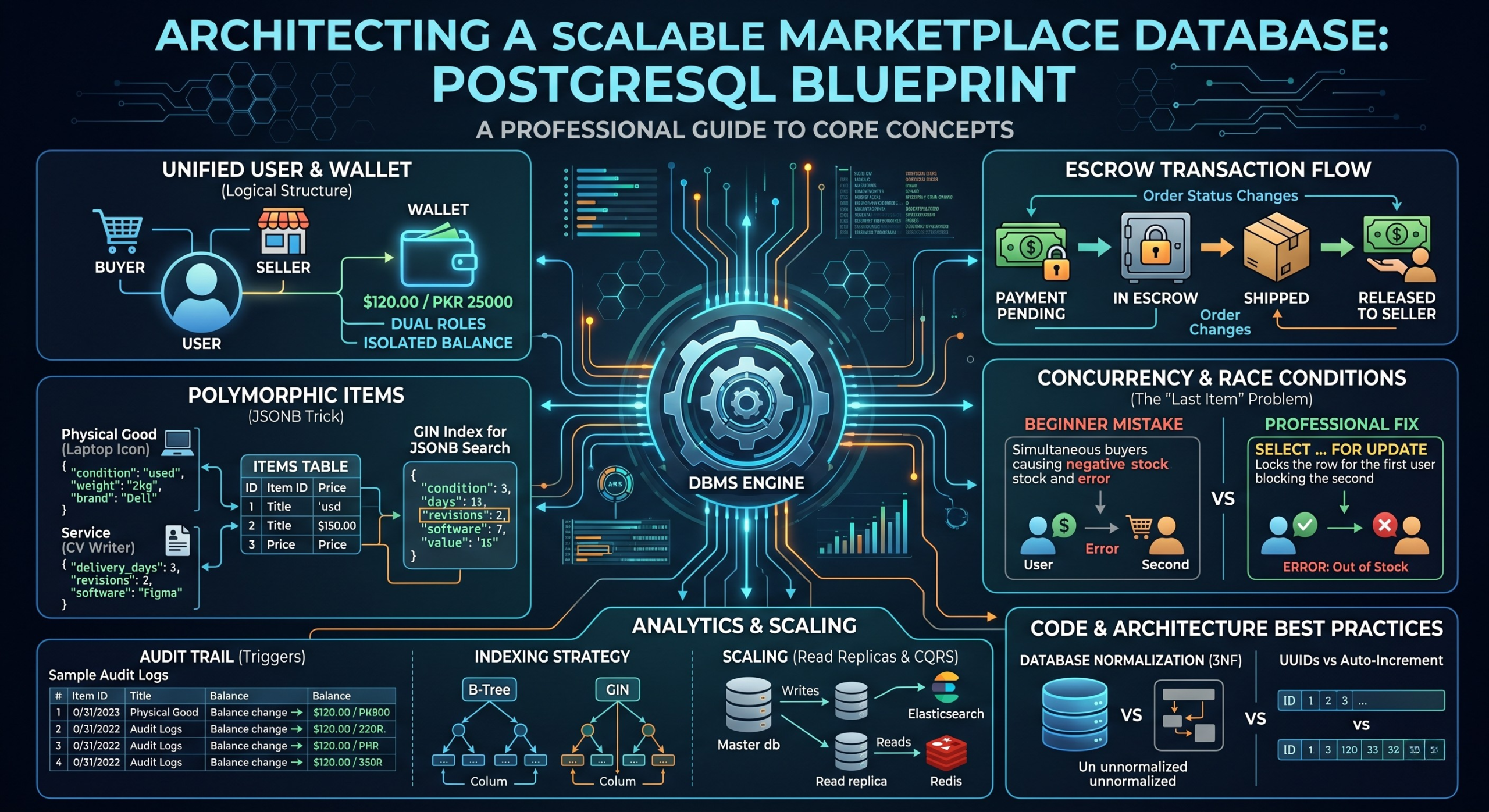
An intricate technical infographic titled "Architecting a Scalable Marketplace Database: PostgreSQL Blueprint: A Professional Guide to Core Concepts." The diagram is centered around a glowing "DBMS ENGINE" hub with circuit traces and includes six key functional panels demonstrating critical engineering pillars. The panels cover: "Unified User & Wallet" showing dual buyer and seller user roles linked to isolated wallet balances; "Polymorphic Items" demonstrating how to store varied goods and services using JSONB and GIN indexing with example JSON data for a laptop and a service; "Escrow Transaction Flow" mapping a linear timeline from payment pending to funds release with order status change icons; "Concurrency & Race Conditions" comparing a "Beginner Mistake" leading to negative stock with a "Professional Fix" using row-level locking with SELECT ... FOR UPDATE; "Analytics & Scaling" with diagrams for audit trails via triggers with example log entries, indexing strategies like B-Tree and GIN, and a system for scaling using read replicas and CQRS; and "Code & Architecture Best Practices" comparing normalized vs non-normalized structures and auto-increment vs UUIDs concept with an example structure. The entire composition uses a clean digital style with glowing data pathways on a dark background.

Picture this: You’ve spent the last six months building a multi-vendor marketplace. The frontend is gorgeous. The animations are buttery smooth. You launch, and within the first hour, you get your first transaction. A user buys a vintage guitar from a seller across the country. You celebrate. Then, five minutes later, a second user buys … Read more

Race Conditions & Semaphores : Handling 500+ Concurrent Users

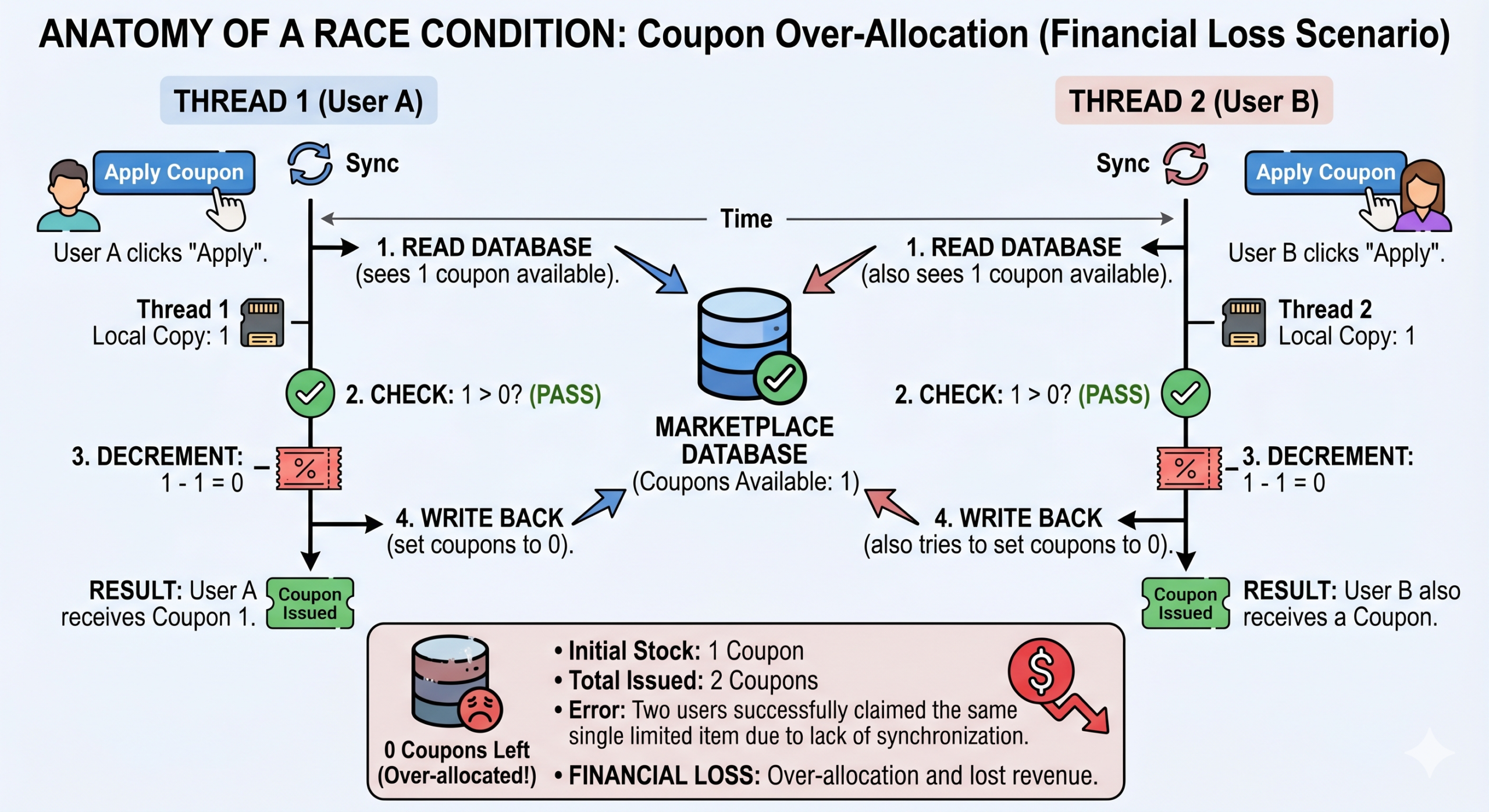
A technical diagram titled "Anatomy of a Race Condition" showing two threads (User A and User B) simultaneously accessing a marketplace database with 1 coupon available. Both threads read the value '1', pass the check, and write back '0', resulting in two coupons being issued for a single stock item, illustrating a financial loss scenario due to a lack of synchronization.

1. The Core Problem: How Does a Race Condition Occur? Imagine you have exactly 50 discount coupons left in your database. When a user clicks “Apply,” the backend server typically executes code in three steps: Read: Check the database for remaining coupons. (e.g., Coupons = 50) Check: Are the remaining coupons > 0? If yes, … Read more