
How to Build a Marketplace Database That Won’t Keep You Up at Night
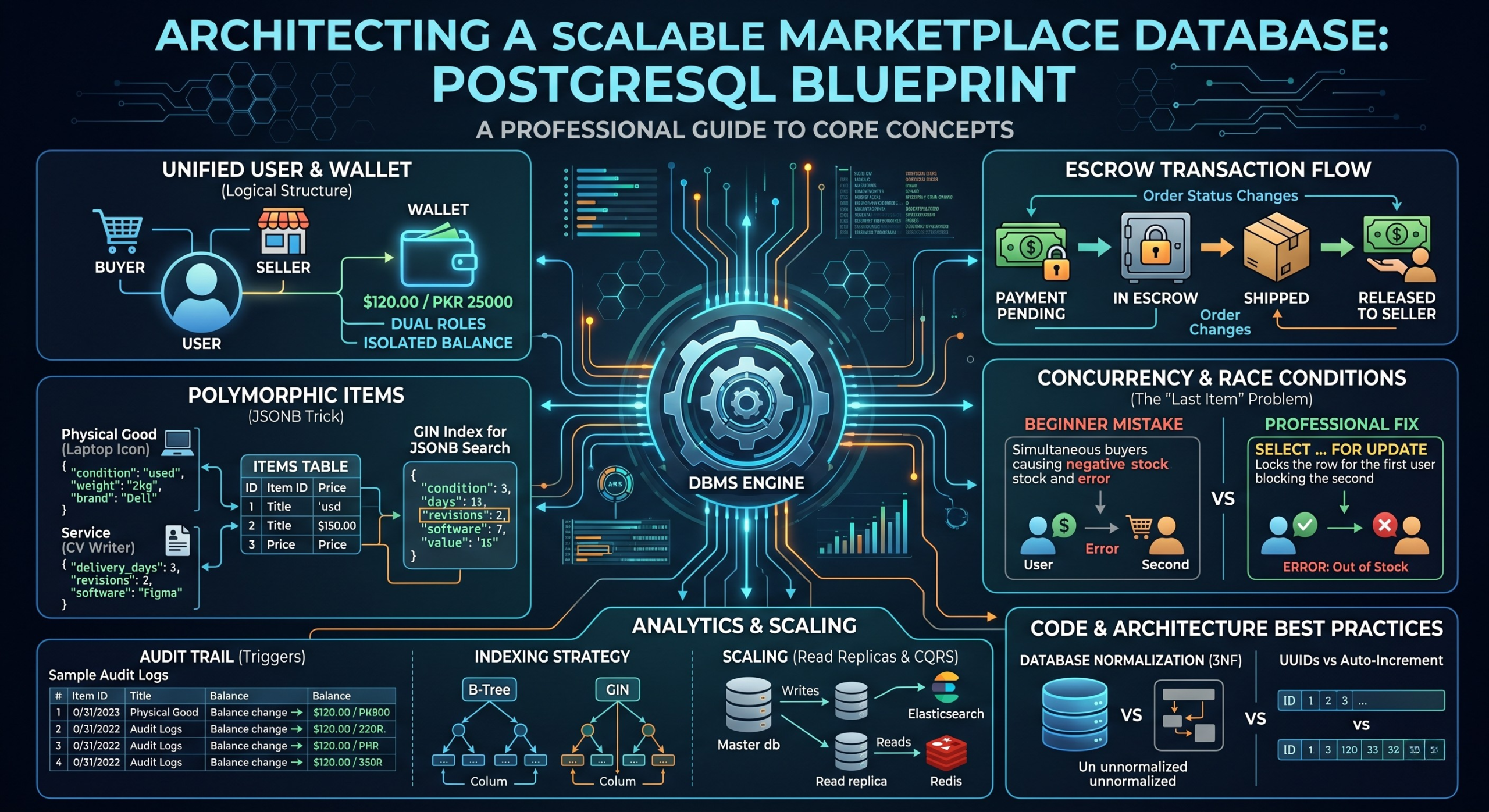
An intricate technical infographic titled "Architecting a Scalable Marketplace Database: PostgreSQL Blueprint: A Professional Guide to Core Concepts." The diagram is centered around a glowing "DBMS ENGINE" hub with circuit traces and includes six key functional panels demonstrating critical engineering pillars. The panels cover: "Unified User & Wallet" showing dual buyer and seller user roles linked to isolated wallet balances; "Polymorphic Items" demonstrating how to store varied goods and services using JSONB and GIN indexing with example JSON data for a laptop and a service; "Escrow Transaction Flow" mapping a linear timeline from payment pending to funds release with order status change icons; "Concurrency & Race Conditions" comparing a "Beginner Mistake" leading to negative stock with a "Professional Fix" using row-level locking with SELECT ... FOR UPDATE; "Analytics & Scaling" with diagrams for audit trails via triggers with example log entries, indexing strategies like B-Tree and GIN, and a system for scaling using read replicas and CQRS; and "Code & Architecture Best Practices" comparing normalized vs non-normalized structures and auto-increment vs UUIDs concept with an example structure. The entire composition uses a clean digital style with glowing data pathways on a dark background.

Picture this: You’ve spent the last six months building a multi-vendor marketplace. The frontend is gorgeous. The animations are buttery smooth. You launch, and within the first hour, you get your first transaction. A user buys a vintage guitar from a seller across the country. You celebrate. Then, five minutes later, a second user buys … Read more