
How requestAnimationFrame and V-Sync Actually Work
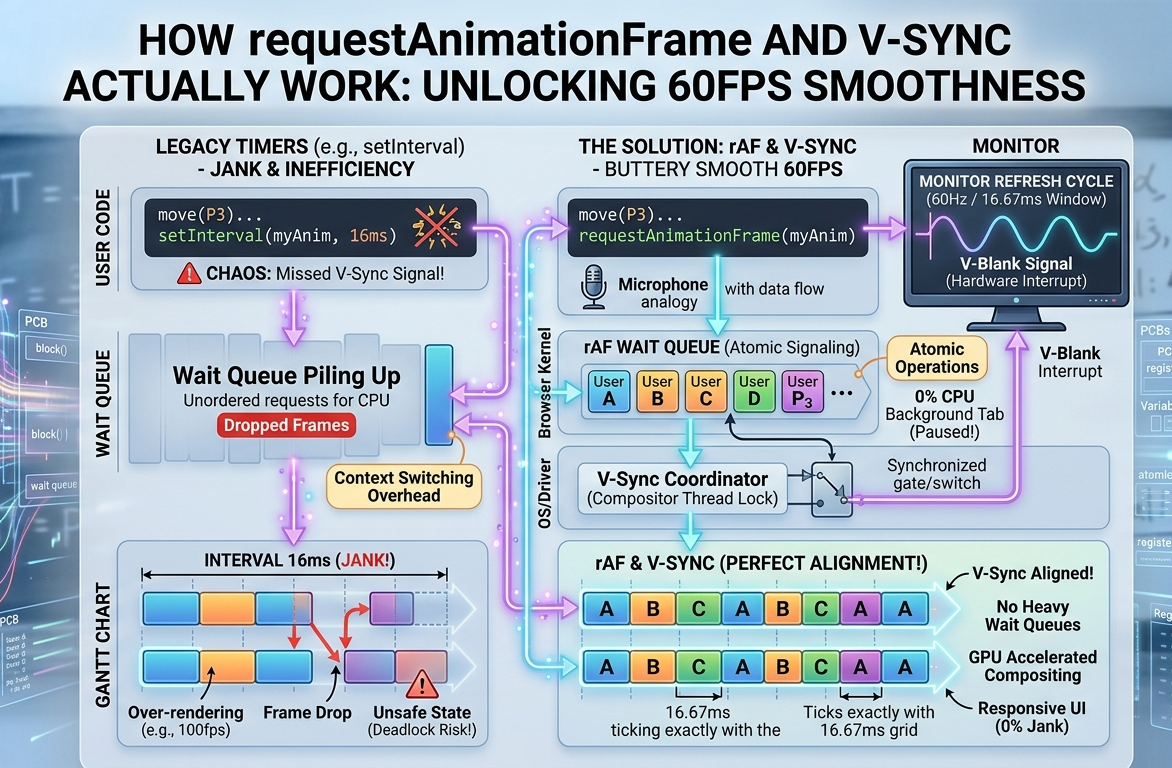
A detailed technical infographic titled "How requestAnimationFrame AND V-Sync ACTUALLY WORK." The image compares legacy timers (setInterval) on the left against the rAF and V-Sync solution on the right. It features a "Wait Queue" visualization where legacy timers cause "Dropped Frames" and "Context Switching Overhead," while the rAF queue shows "Atomic Signaling" and "Synchronized switching." A central Gantt chart compares jagged 16ms intervals (Jank) with perfect V-Sync alignment (Buttery Smooth). The background includes a classroom chalkboard with OS formulas for Turnaround Time (TAT) and Waiting Time (WT), bridging web development with OS kernel concepts.

Achieving 60 frames per second (fps) in web animation is often treated as the holy grail of frontend development. When you are building high-end interfaces—perhaps utilizing tools like GSAP or crafting intricate Bento Box layouts—you expect your animations to be buttery smooth. But smooth animation is not just about writing clean CSS or efficient JavaScript. … Read more
10 Essential Webpage Animations to Alert Users (With UX Best Practices)

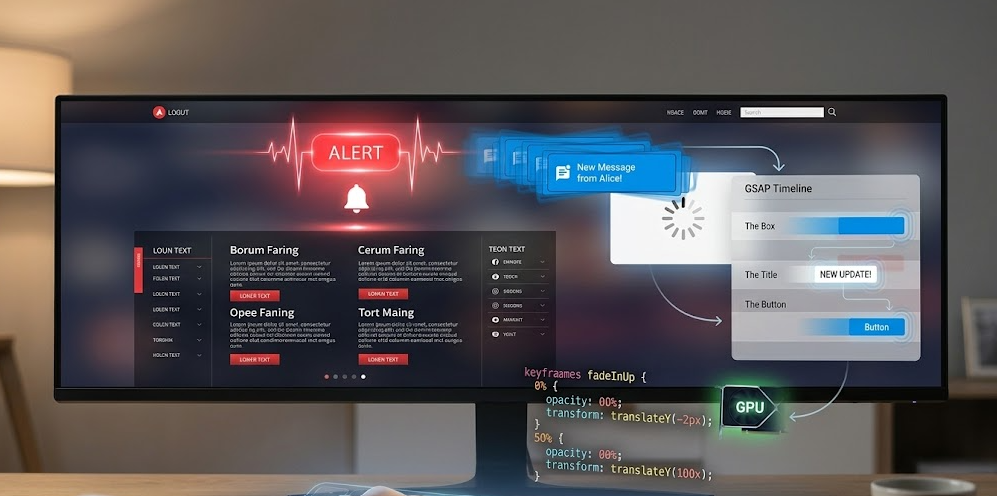
A panoramic digital mockup of a webpage. Multiple conceptual elements from the article's 10 headings are visible: a user's hand triggers a dynamic alert, transitioning to visual motion trails that include a standard spinner, a pulsing notification, and a full GSAP timeline interface showing sequential flow of multi-element alerts. Simplified code and a small GPU icon visualize optimization, summarizing all strategic motion concepts.

We’ve all been there: you’re staring at a webpage, you click a button, and… nothing happens. Or so it seems. Ten seconds later, you realize a tiny red error message appeared at the top of the page, but you completely missed it because you were looking at the bottom. This is where webpage animations to … Read more