
How to Build a Marketplace Database That Won’t Keep You Up at Night
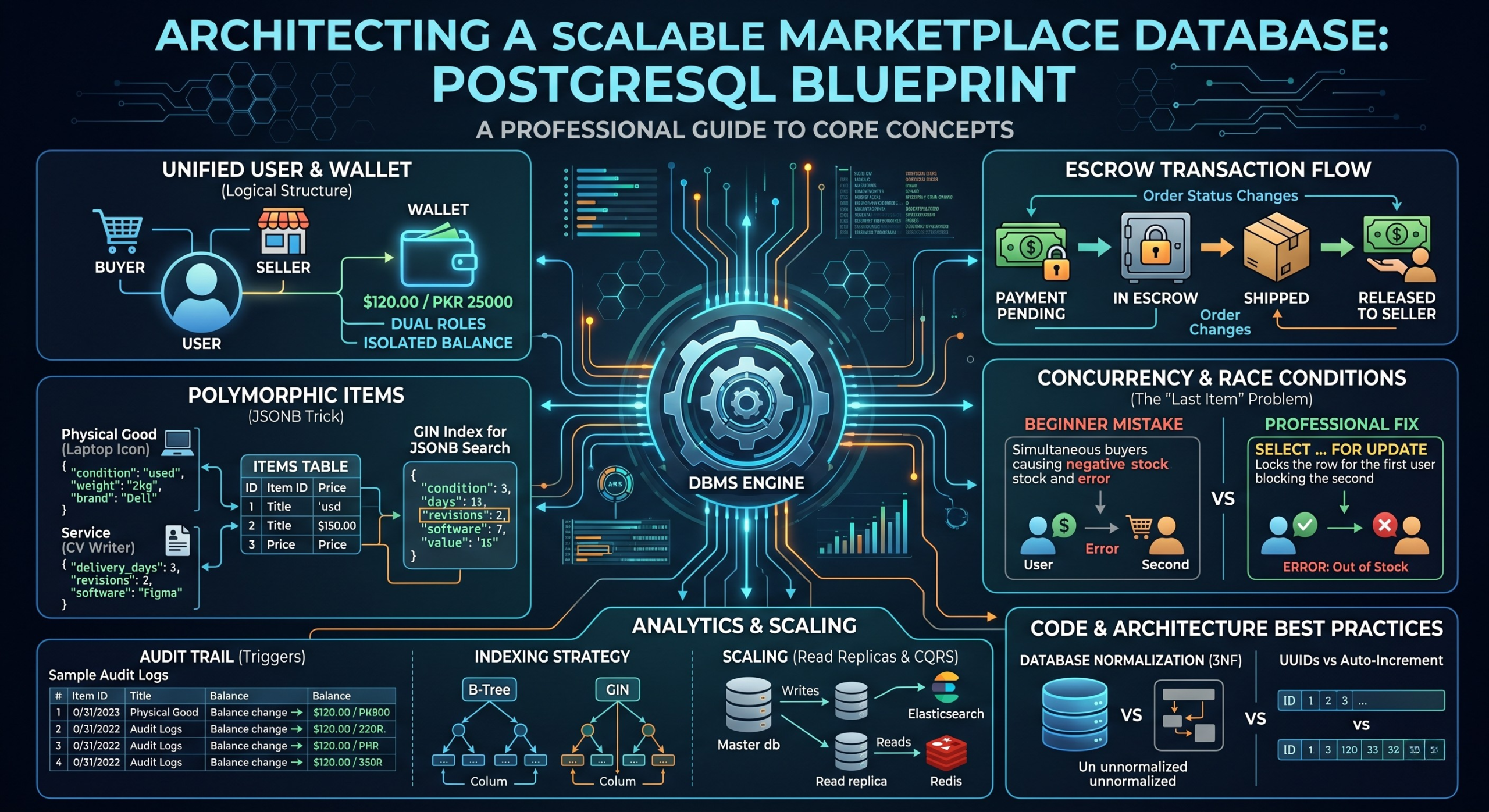
An intricate technical infographic titled "Architecting a Scalable Marketplace Database: PostgreSQL Blueprint: A Professional Guide to Core Concepts." The diagram is centered around a glowing "DBMS ENGINE" hub with circuit traces and includes six key functional panels demonstrating critical engineering pillars. The panels cover: "Unified User & Wallet" showing dual buyer and seller user roles linked to isolated wallet balances; "Polymorphic Items" demonstrating how to store varied goods and services using JSONB and GIN indexing with example JSON data for a laptop and a service; "Escrow Transaction Flow" mapping a linear timeline from payment pending to funds release with order status change icons; "Concurrency & Race Conditions" comparing a "Beginner Mistake" leading to negative stock with a "Professional Fix" using row-level locking with SELECT ... FOR UPDATE; "Analytics & Scaling" with diagrams for audit trails via triggers with example log entries, indexing strategies like B-Tree and GIN, and a system for scaling using read replicas and CQRS; and "Code & Architecture Best Practices" comparing normalized vs non-normalized structures and auto-increment vs UUIDs concept with an example structure. The entire composition uses a clean digital style with glowing data pathways on a dark background.

Picture this: You’ve spent the last six months building a multi-vendor marketplace. The frontend is gorgeous. The animations are buttery smooth. You launch, and within the first hour, you get your first transaction. A user buys a vintage guitar from a seller across the country. You celebrate. Then, five minutes later, a second user buys … Read more
Demystifying Database Architecture: Physical vs Logical Data Storage Explained

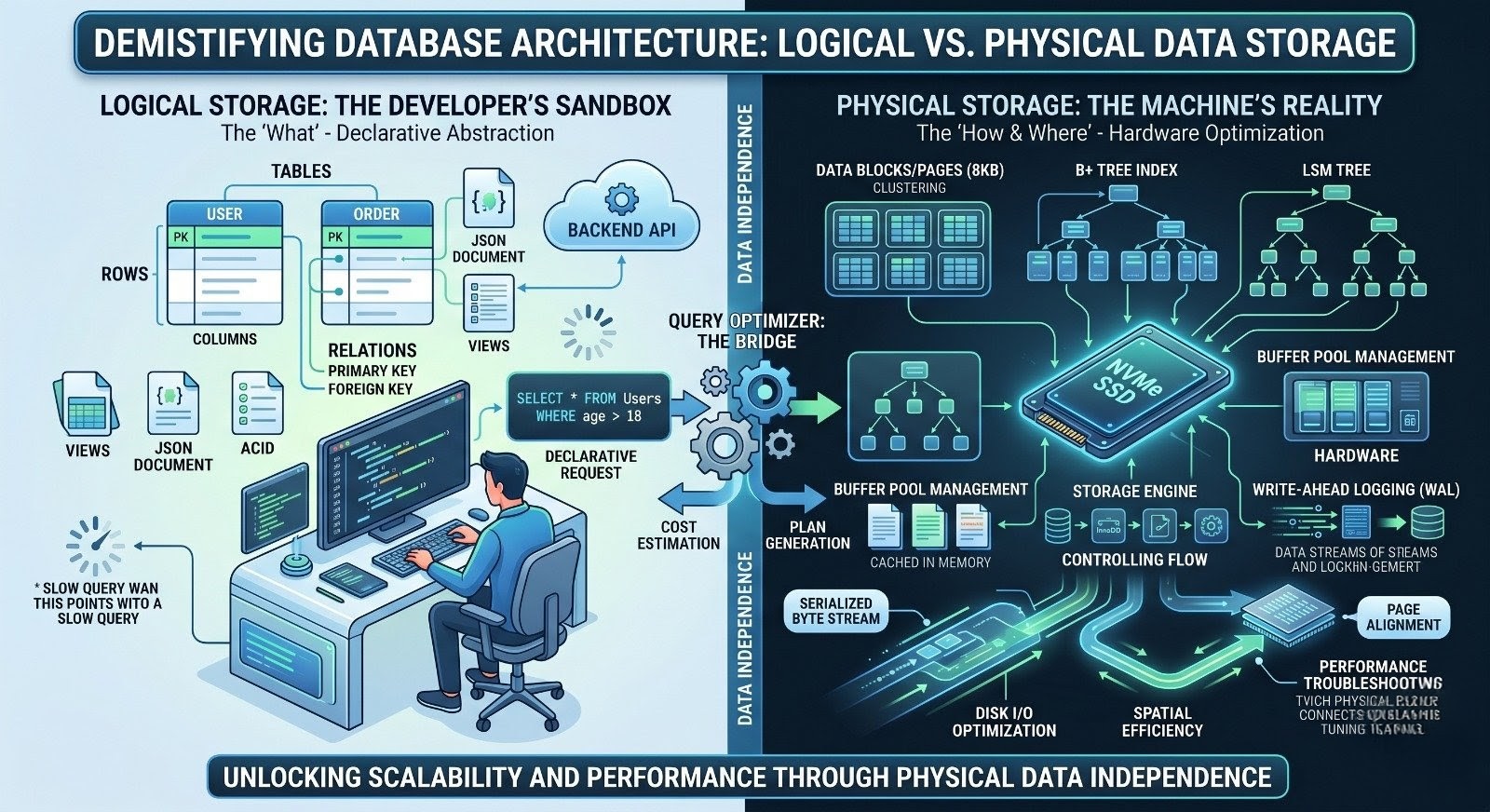
"An architectural diagram illustrating the separation of logical data storage, showing developer tables and queries, from physical data storage, showing disk blocks and B+ Trees, connected by a query optimizer with the help of Database-Architecture."

If you have ever stared at a spinning loading wheel on a web application, you have likely witnessed a database architecture struggling to bridge the gap between human logic and machine reality. In backend architecture, data does not exist in a single state. It lives a double life. On one side, it exists as a … Read more

Complete Guide to Database Engineering Fundamentals

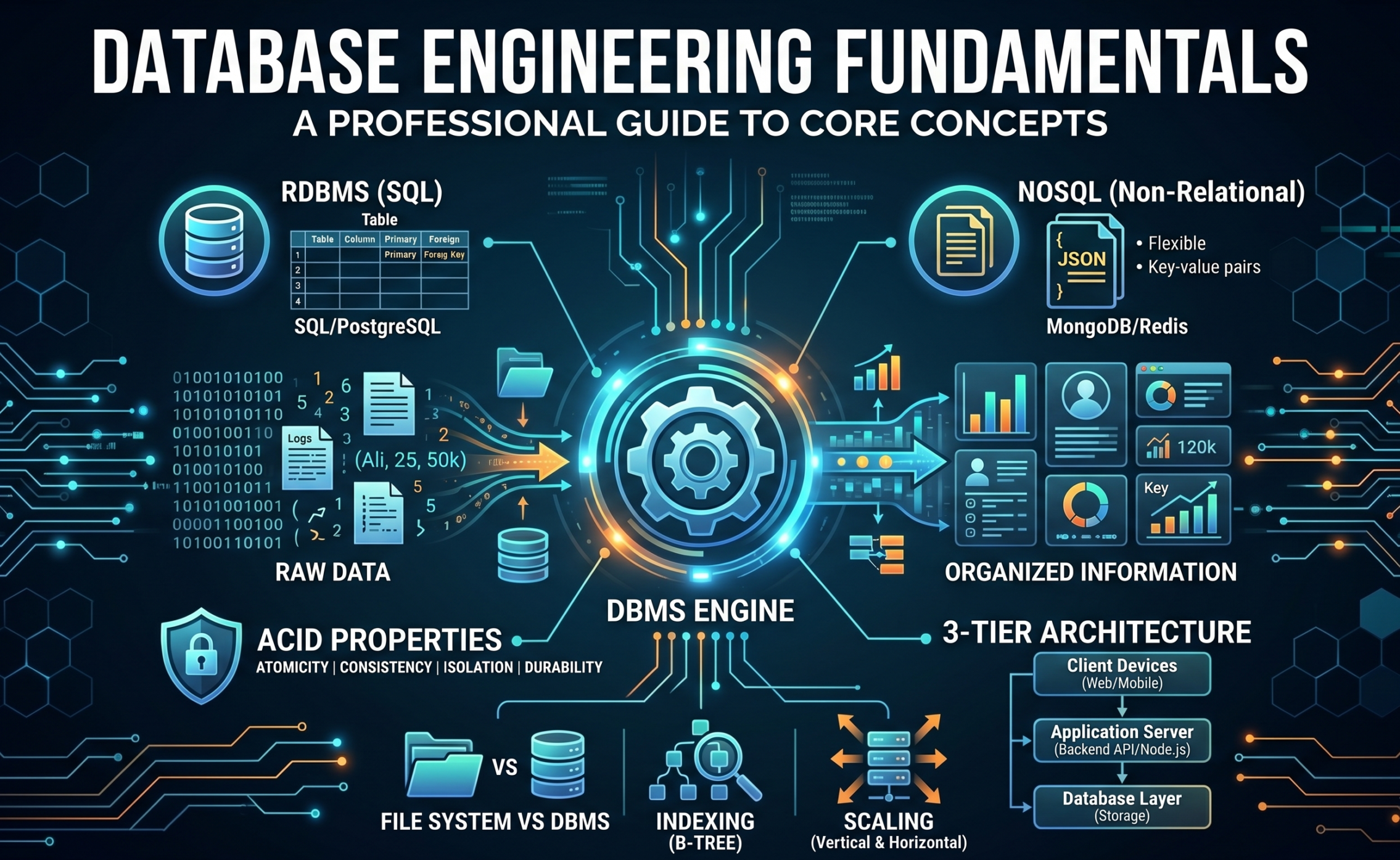
At the enterprise level, we don't just "save data." We build Data Pipelines. Database Engineering Fundamentals

1. Data vs. Information People often use these terms interchangeably, but in database engineering, there is a massive difference. Data (Raw Material): This refers to unorganized, raw facts and figures. It holds no specific meaning on its own. Example: A list containing [Ali, 25, 50000, NYC]. This is just data. Without context, we don’t know … Read more