
What is compliance.ai ?
In a very simplified sense, Compliance.ai is basically a search engine with a monitoring AI, used for companies operating in regulated industries (finance or insurance) to manage the overwhelming stream of legal and regulatory changes they encounter every day. Compliance.ai is a regulatory change management platform for Regulatory Intelligence. It leverages AI to independently collect, categorize, and prioritize regulatory changes from various governmental sources for compliance professionals.
AI Compliance Company’s Main 3 Pillars
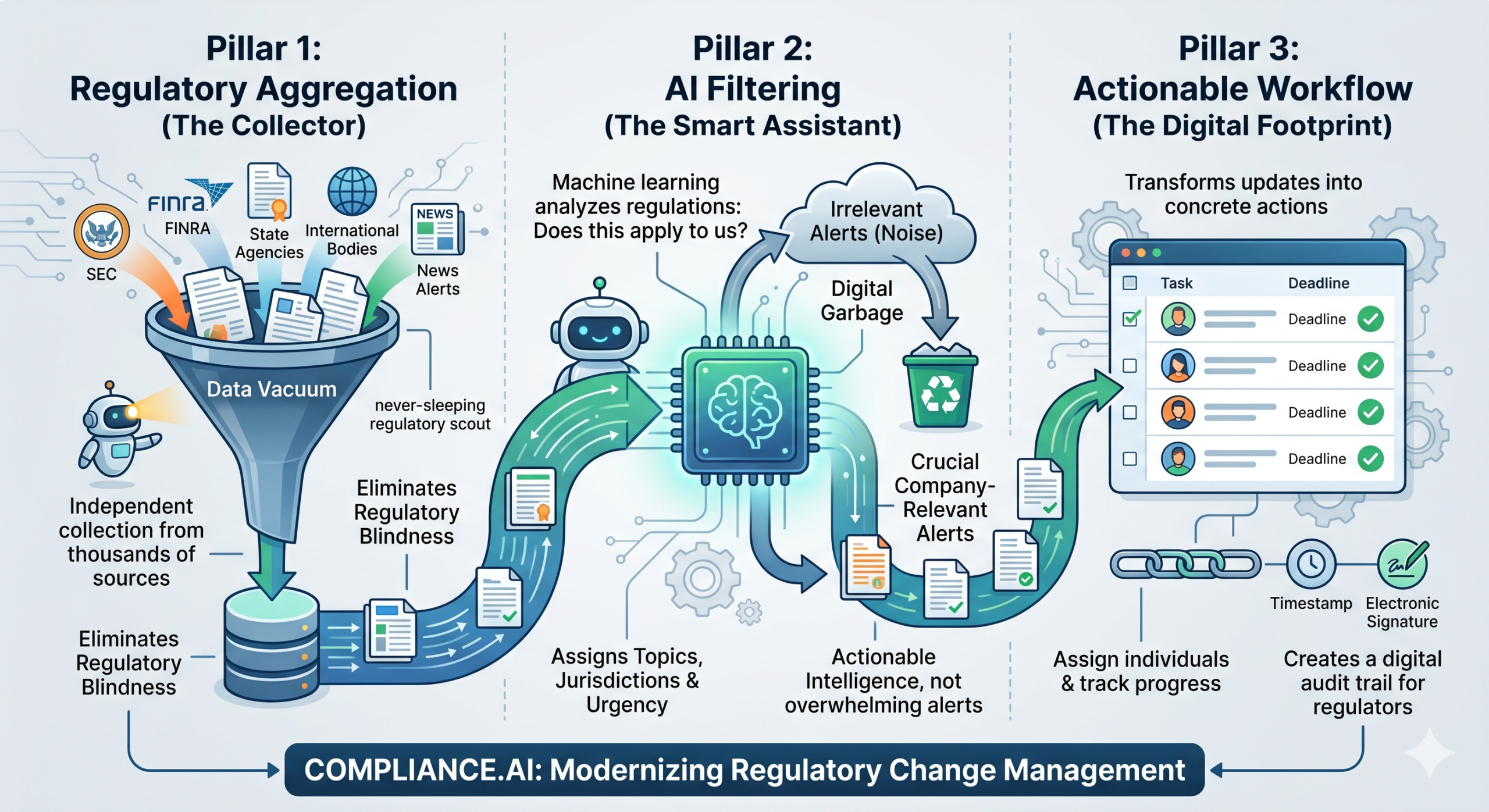
1. The Aggregator (The Collector):
And so we came up with what we call, “never-sleeping regulatory scout”; it’s “The Aggregator”. Back in the days it was a person on site and spending just hours each day and that what they called “site hopping” which would be we go to view SEC’s site, then maybe go to some state agency website, then look up on some international news web page to maybe try and dig out some newly posted announcement. It is extremely inefficient, and you’re going to miss something very small and yet critical, somewhere on the 10th page of a government agency PDF. And so at compliance.ai, we position ourselves as a, what do you call it, “strong industrial strength data vacuum” that sucks up information from tens of thousands of very different sources, all the way from FINRA and the federal agencies through small state agencies, all the way down to international regulatory bodies. So we’ll, take that, feed that into a nice clean feed, and then humans stop being blind…you know, we stop having regulatory blindness, where it becomes humanly difficult not to notice that one tiny little regulatory change that was placed on one tiny government website; and we, empower human beings to stop the data collection and start the risk management.
Our portfolio Makeuser
2. The Filter or AI of Compliance:
The Aggregator is “what pulls in all of the data, but what really understands what is being looked at is the Filter.” The Filter is our smart assistant that knows everything about our business; otherwise, our Compliance Officer sees over a thousand morning alerts about issues that they have nothing to do with. It is the equivalent of trying to find a needle in a haystack when a fresh pile of hay is being poured on your head.
It is machine learning that drives our “noise-cancellation” in the sense that we analyze new regulations, asking, “Does this apply to us?” Thus a regional bank in Ohio without cryptocurrency exposure can be instantly told that the new crypto regulation is “noise” and directed elsewhere. Because we are able to assign topics, jurisdictions, and urgency to the data, the Compliance Officer will be seeing just 5 crucial company-relevant alerts in the morning rather than thousands of seemingly random updates.
“Big Data” becomes “Actionable Intelligence”, and human knowledge is then focused on the actual threat as opposed to sifting through “digital garbage”.
3. The Workflow (The Action):
So you know the usual pattern in an office – a new regulation is uncovered; a panic email is sent out, a spreadsheet is populated… and then that falls off the edge of the desk into the ‘black hole’ that says ‘I thought you were dealing with this.’ Workflow eliminates that entirely. It effectively transforms a regulatory update into a concrete action, with individuals assigned, deadlines to fulfill the action, and the ability to track progress on that specific action.
And it is ‘Action’ because you now create a digital footprint. When the regulator turns up at your doorstep two years down the line and asks you, “Why were you non-compliant with the 2024 regulation?”, you can open up that Workflow and demonstrate the timestamp that the notice was received, the individuals who amended the relevant policy, and the electronic signature showing that the action was executed. It is about moving from the position of “we’re aware the law has changed” to “we have changed how we do business,” and workflow, as one of the pillars, helps to span that gap.
3 Pillars Triangler:
Thus, the three elements described above are the “nervous system” within a company, and once removed, the entire body ceases to function. Without the Aggregator, the company is virtually “blind”, with no notification of regulations being released. Even with perfect Aggregation, a company lacking the Filter will encounter “information overload”, making it impossible to perform tasks through analysis of 1,000 potential threats that the business needs to consider. And even with all of the data perfectly sorted and filtered, there will be “no purpose” without the Workflow. Data that does not translate to action becomes nothing more than a trivial pursuit, with knowledge of a regulation but the possibility of fines of millions of dollars for non-compliance. The Aggregator finds the threat, the Filter categorizes and prioritizes the threats, and the Workflow deals with the concerns.
Automated Marketing Compliance & Content Review
The Red Marker’s role is like a ‘safety net’ for a firm’s creative content. With regulated industries such as banking and insurance firms, it’s imperative that all of their social media posts, brochures, and any new content placed on the web be legally sound. Their technology uses the content and runs it through the system in real time to identify any risky claims and any missing disclosures before they’re published on the internet. The old ‘wait days for legal to review a document’ has gone, with the type of AI used, there’s real-time feedback on whether the marketing content both meets industry guidelines as well as brand policies.
Proactive Risk Detection with RiskGPT of AI Compliance Company
What lies at the heart of the platform’s intelligence is the understanding of the subtlety of language and visual data. The specialized RiskGPT engine at the center of Red Marker allows the tool to interpret not only keywords in a marketing message, but also the context they are used in. For example, if the words “guaranteed returns” appear in an ad, the AI will automatically flag this as a high-risk statement and propose a safer wording. It’s even possible for the tool to check the ‘fine print’ and make sure the size of the font doesn’t violate legal rules, thus detecting the type of mistake human eyes can miss, and that could cost huge fines or reputation.
AI Compliance’s IntelligenceBank Ecosystem
Since the 2024 acquisition, Red Marker has integrated itself into the IntelligenceBank’s content governance offerings, allowing organisations to manage assets from their initial production to storage to their final approval to distribution in one central environment. Embedding compliance checks into the tools that marketing people use daily means marketers are no longer slowed down by the traditional ‘bottleneck’ process of waiting for approval by Legal. This synergy permits large organisations to move more quickly, be more agile, and launch campaigns faster while having the most robust digital audit trail for their regulators.
Review of Beginner and Problems with Implementation and Modifications of compliance.ai
Beginner’s View: Implementation Obstacles. Many new users feel that turning on Compliance.ai is similar to being given the keys to an F-22 fighter jet when all you have ever driven is an Oldsmobile Cutlass. Although this software is amazing, a huge obstacle that new users have is “bigness.” Most people feel that implementing the software is difficult because you are truly building the system to teach the AI what you need to identify; if you are not precise about what your company’s business niche is, you will be barraged with “false positives.” Many people expect that when they open up Compliance.ai to get useful information, but what they receive is an overload of alerts that are irrelevant to their company, which can make the system more time-consuming and harder to use than the manual labor it was meant to replace.
The real struggle, in this aspect, is the process of “implementation and fine-tuning.” One cannot expect a system this advanced to be as easy as a “plug and play” system; it requires trial and error to discover what will and what will not work within your system to identify your specific business “vibe.” Many users take longer than expected to implement the software because of the struggle of making the system work and correctly identifying things that truly pertain to your specific business; if your filters are too wide, you drown in information, and if they are too narrow, you miss key issues. Many beginners find that this process of fine-tuning is one of the larger obstacles before the value of the software begins to show itself.