
Picture this: You’ve spent the last six months building a multi-vendor marketplace. The frontend is gorgeous. The animations are buttery smooth. You launch, and within the first hour, you get your first transaction. A user buys a vintage guitar from a seller across the country. You celebrate.
Then, five minutes later, a second user buys the exact same guitar.
Your stomach drops. You check your database. You only had one guitar in stock, but somehow, two people bought it. Now you have to email a very angry customer, refund their money, and figure out how your system just sold thin air.
Building a standard, single-vendor e-commerce store is a solved problem. You put items on a digital shelf, people buy them, end of story. But building a multi-vendor marketplace like Airbnb, Fiverr, or a campus trading hub is a completely different beast.
In a marketplace, your database isn’t just a place to store data. It’s a digital bank and a trust engine. You are suddenly responsible for routing other people’s money, holding funds in escrow, and making sure that thousands of people clicking “Buy” at the exact same millisecond doesn’t burn your server to the ground.
If your frontend crashes, the user refreshes the page. If your database state gets corrupted, your business might be over.
So, how do we build this the right way? Grab a coffee, and let’s talk about how professional engineers architect scalable, sleep-easy marketplace databases using PostgreSQL.
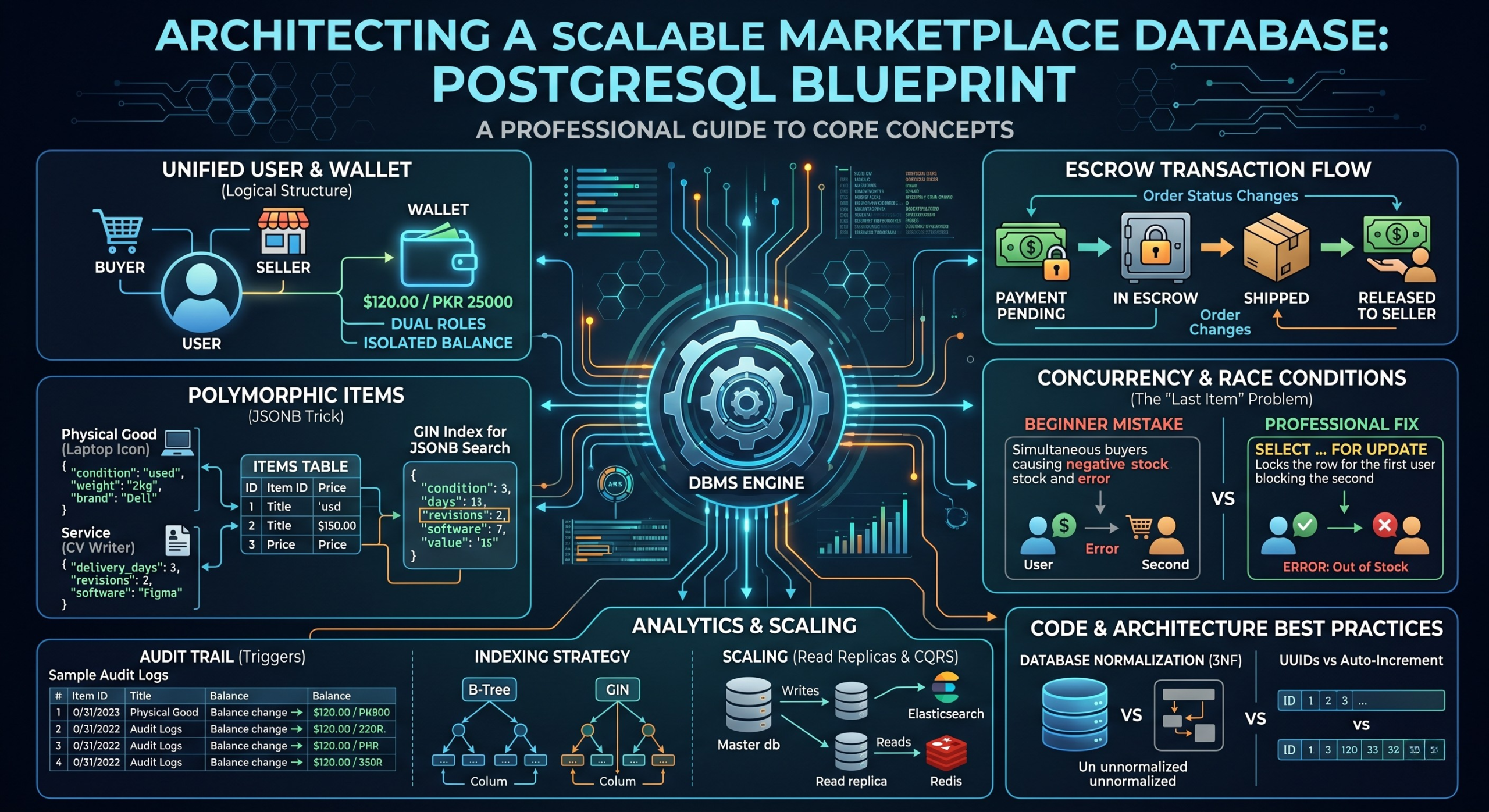
1. Stop Splitting Your Users (The Unified Identity)
When developers build their first marketplace, they usually make a very logical, but ultimately fatal, mistake: they create a Buyers table and a Sellers table.
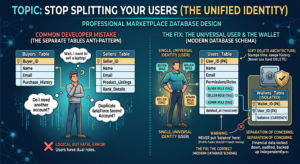
It makes sense in theory, right? They do different things. But here is the reality of modern platforms: the person who buys a textbook from your site today might decide to sell their old laptop on your site tomorrow.
If you have separate tables, what do you do? Force them to make a second account? Duplicate their data?
The Fix: The Universal User and the Wallet
We solve this by creating a single, universal Users table. A user’s “role” (buyer, seller, admin) isn’t a structural division; it’s just a state or a permission tag applied to their account.
More importantly, because this is a marketplace, your users now have financial balances. Never put a balance column inside your Users table. If someone hacks a user’s profile to change their name, they shouldn’t be anywhere near their money.
Instead, create a strictly isolated Wallets table that references the user’s ID. This separation of concerns means your financial data can be locked down, audited, and backed up entirely independently of whether someone updated their profile picture.
A Quick Note on “Deleting” Data: If a user gets mad and clicks “Delete Account,” doing a hard SQL
DELETEis a catastrophe. If User A bought something from User B, and User B deletes their account, a hard delete will wipe out the historical transaction record and break your accounting. Always use Soft Deletes. Add adeleted_attimestamp column. When someone leaves, just stamp the time. They disappear from the public site, but your financial ledgers remain legally intact.
2. The “Sparse Table” Nightmare (Enter JSONB)
Let’s say your marketplace allows users to sell physical goods (like a camera) and digital services (like photo editing).
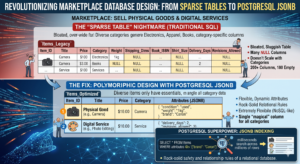
If you try to fit both of these into a standard SQL table, you are going to have a bad time. You’ll create a Weight and Shipping_Dimensions column for the camera. But when someone lists a digital photo editing service, those columns will just sit there, completely empty (NULL). Conversely, the Delivery_Days and Revisions_Allowed columns for the service will be entirely blank for the camera.
As your marketplace grows into dozens of categories, your database table becomes a bloated, sluggish monster with 200 columns, 180 of which are empty on any given row. We call this a “Sparse Table.”
The Fix: Polymorphic Design with PostgreSQL JSONB
Instead of creating hundreds of columns, we use PostgreSQL’s superpower: JSONB.
You create one unified Items table with only the absolute essentials: Item_ID, Title, Price, and Category.
Then, you create a single magical column named Attributes with the JSONB data type.
-
When someone lists a camera, your backend just tosses a JSON object in there:
{"condition": "used", "weight": "1kg", "brand": "Canon"}. -
When someone lists a service, it gets its own JSON:
{"delivery_days": 2, "revisions_allowed": 3}.
You get the extreme flexibility of a NoSQL database (like MongoDB), but you keep the rock-solid safety and relationship rules of a relational database. Best of all? PostgreSQL lets you index that JSON data. You can search across millions of rows for {"brand": "Canon"} inside the JSON blob, and it will return the results in milliseconds.
Our Portfolio Makeuser
3. You’re a Bank Now (Escrow and The Impatient Clicker)
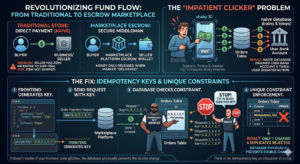
In a traditional store, money goes from the customer to the business. In a marketplace, if you send the buyer’s money directly to the seller, the seller has zero incentive to actually ship the item.
You have to act as the middleman. Your Orders table needs a strict state machine. The money goes from the buyer, into your platform’s Escrow state, and only moves to the seller’s wallet when the item is marked as delivered.
But dealing with money introduces human unpredictability.
Imagine a user on a shaky 3G connection on a train. They hit the “Pay” button. Nothing happens. They panic and mash the “Pay” button four more times. If your database is naive, you just drained their bank account five times.
The Fix: Idempotency Keys
Your database must enforce idempotency. Think of an idempotency key as a bouncer at a club. When the user hits checkout, your frontend generates a unique, random string of text (the key) and sends it with the payment request.
You set that key as a UNIQUE constraint in your Orders table. If the impatient user clicks the button five times, the database looks at the second request, says, “I’ve already seen this exact key,” and immediately rejects it at the database level. It doesn’t matter if your frontend code glitches; the database physically prevents the double-charge.
4. The Race Condition (Or, How to Sell One Item to Three People)

This brings us back to our nightmare scenario at the beginning of the article: The Double Booking.
Why did it happen? Because code takes time to execute.
-
Buyer A clicks buy. The database checks the stock. (Stock = 1).
-
One millisecond later, Buyer B clicks buy. The database checks the stock. (Stock = 1).
-
The database lets Buyer A buy it. (Stock goes to 0).
-
The database lets Buyer B buy it. (Stock goes to -1).
This is called a Race Condition, and it is the hallmark of amateur architecture.
The Fix: Pessimistic Row-Level Locking
We solve this by telling the database to become incredibly selfish. We use an SQL command called SELECT ... FOR UPDATE.
When Buyer A clicks checkout, the database goes to that specific item’s row and puts a “Do Not Disturb” sign on the door (a lock). When Buyer B arrives a millisecond later, the database engine literally pauses Buyer B’s request. It forces them to wait in the hallway.
Once Buyer A’s transaction finishes and the stock drops to 0, the lock is removed. Buyer B’s request is allowed in, sees that the stock is now 0, and gracefully fails, telling the user “Sorry, out of stock!”
By wrapping your checkout process in a locked database transaction, you guarantee absolute mathematical consistency. You could have a million people click buy at the exact same second, and the database will flawlessly queue them up and only sell the single item once.
5. Growing Pains (Preparing for the Big Leagues)
If you build your foundation with unified users, JSONB flexibility, strict escrow states, and pessimistic locking, you will survive your launch. But what happens when you start getting 50,000 visitors a day?
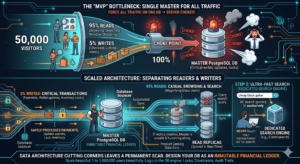
In a marketplace, traffic is heavily skewed. 95% of your users are just browsing, searching, and window-shopping (Reads). Only 5% are actually checking out or listing items (Writes).
If you force all 50,000 people to search for items on the exact same database instance that is trying to safely process payments, your server will choke.
The Fix: Separate the Readers from the Writers
As you scale, you implement Read Replicas. You keep your main “Master” PostgreSQL database entirely focused on the critical stuff: taking money, updating wallets, and locking inventory.
Then, you spin up exact copies of that database (Replicas) that sync in real-time. You route all the casual browsing and searching traffic to the replicas. If a replica crashes because someone ran a crazy search query, who cares? Your Master database is still humming along safely, processing payments.
Eventually, for ultra-fast searches, you’ll sync your product catalog to a dedicated search engine like Elasticsearch, ensuring that when someone types “cheap black guitar” into the search bar, they get results instantly, without ever touching your main transactional database.
The Bottom Line
Building a marketplace is a marathon. It’s tempting to cut corners to get an MVP out the door quickly. But data architecture is the one place where cutting corners leaves a permanent scar.
Design your database not just as a place to dump text, but as an immutable, heavily guarded financial ledger. If you put the heavy logic the locks, the constraints, the audit trails down into the database engine itself, your application will scale beautifully from your first user to your first million.